
In our last WEST post we asked if you could spot the commission in the very comprehensive survey AI gave of the Western Esoteric Tradition. I’m sure you discovered that the commission was Christ.
My own outline looked like this:
***********************
Atlantean prologue
Beginnings and definitions
- Eso / Exo teros
- Emic / Etic
Egypt
- Magic
- Religion
- Temples
- Priesthood
- Om Sety
Greece
- Pythagoras - training in Egypt
- Reincarnation
- Philosophers
- Not the rational thinkers of modern understanding
- Mysteries
Rome
- Mithras
Christ
- Inner circle of disciples
- Inner meaning of parables
- Hidden meanings that we have lost
- Reincarnation
-
Paul
- Initiation language
- Gnosis
- Church Fathers
- Clement - Stromateis
- Origen
- Pontus Evagrius
- Church development - exoteric stream
- Gnostics
And much more …
***********************
Christ is the missing element. Without this essential piece of the puzzle, we cannot make sense of the esoteric tradition in the West.
AI then is helpful, but we human beings still have provide real spiritual insight.
Of course, you noticed that AI slid itself into the conversation in the last part of its outline:
- 25 Future of Western Esotericism
- Predictions and trends in the evolution of Western esoteric practices
- How modern technology is influencing esoteric traditions
Today we are going to begin at the beginning (or nearby) and answer that very significant question:
Are You In or Out?
If all began with Pythagoras. Today most of us remember Pythagoras as the inventor of a theorem about right angled triangles that may have teased or tormented us through high school maths classes. Pythagoras probably did not invent the equation that bears his name, but he was a remarkable individual.
As a young man he travelled extensively through out the East including Persia, Chaldea, Phoenicia and Egypt. During this time he claimed to have received initiation into different religious traditions. When he finally returned to Greece he attracted students wherever he went. Eventually he settled in the Greek colony of Crotona establishing the first Pythagorean community and school.
When Pythagoras taught, he spoke from behind a screen. His listeners were divided into two groups. Those who were allowed to sit inside the screen, in the ‘in’ (Greek eso) place (Greek teros) were the esoterics. Those who had to sit outside the screen were the exoterics (Greek exo outside plus teros place).
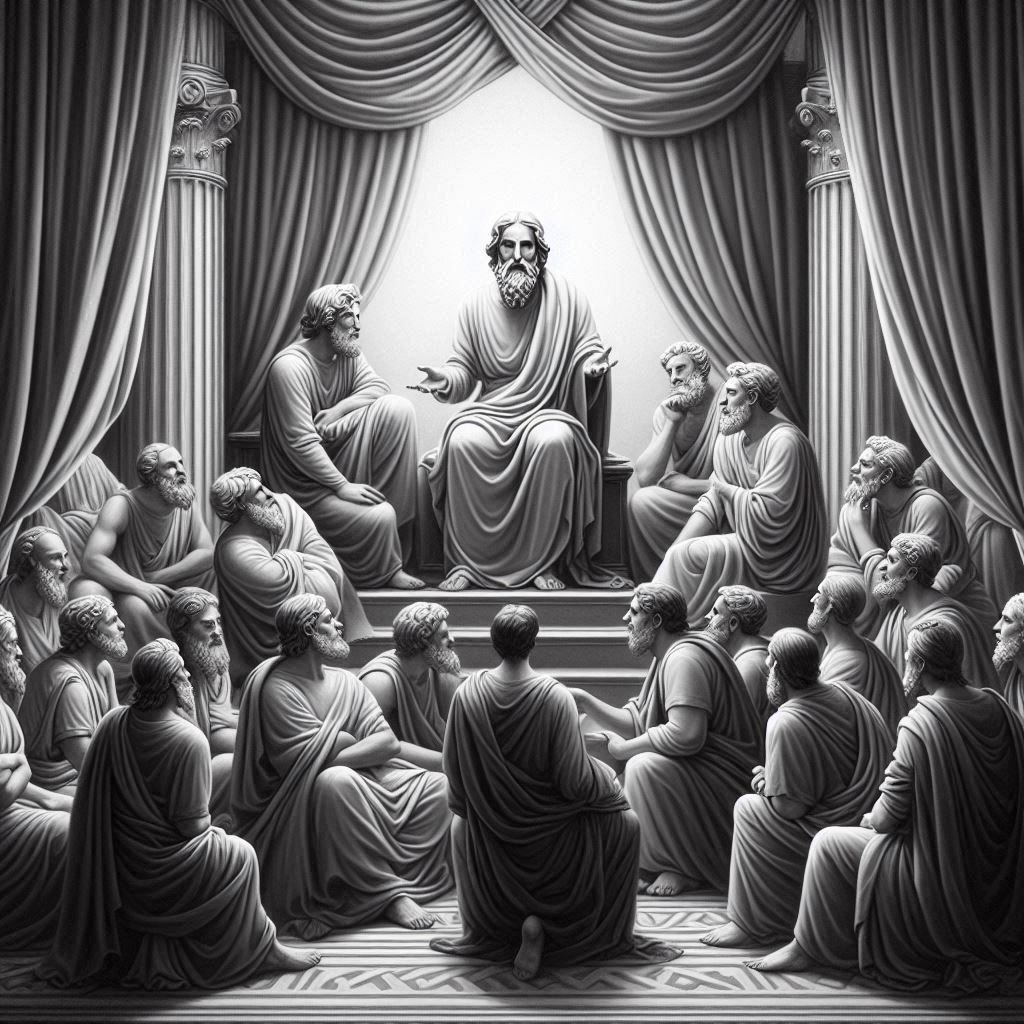
The esoterics then were the insiders. The exoterics were those on the outside.
What did the esoterics receive that the exoterics didn’t? They heard all the instructions that Pythagoras whispered to those on the inside. They got the inside instructions that Pythagoras passed on to his most trusted students.
The esoteric, then is that which is communicated to a chosen few. The exoteric is that which is available to those outside the inner circle.
This concept of transfer of knowledge is very commonplace. Look at the statement below:

Does it have any meaning for you? If you are part of the 99% of the population you may well say that this is gibberish. Only the privileged 1% will be able to identify this set of hieroglyphs as the Schrodinger Wave Equation, a foundation of Quantum Mechanics, one of the two revolutionary pillars of science in the twentieth century. So this is an esoteric statement. Only those who have received the necessary training can find meaning in it.
There are two types of esoteric knowledge. The first, we could call a weak esotericism. This is knowledge that is reserved for a privileged few. This may be advanced mathematics, or specialised knowledge of any form. However, what we are talking about in this book is a strong esotericism. This is a knowledge that is not only reserved for a few, it is reserved for those few who are ready to receive if not their soul.
In the West strong esotericism generally has the following characteristics:
Reincarnation
The recognition of spiritual worlds
Seven (or more) spheres of consciousness
The ascent/descent of the soul into different spheres
A description of the nature of the soul
A transformational body of spiritual knowledge
A lineage or transmission.
As we follow the path of esoteric tradition in the West, we shall see that these seven conditions are fulfilled from century to century and from millennium to millennium.
Here Come the Scholars…
Probably scholars have always been with us. They are those for whom facts rate higher than poetry, and opinions of peers rate higher than truth.
In the last 500 years universities have emerged as the ultimate arbiters of truth in human affairs. Partly this has been the result of the remarkable successes of the sciences in delivering enormous results to humanity. Physics, Chemistry, Mathematics, and Biology delivered electricity, magnetism, millions and millions of food and household products, genetics, understanding the human genome, just to mention a few items.
Of course the success of these new comers to the Academy lead other disciplines to apply their protocols of evidence based, peer referenced writing to many other disciplines, including the discipline of History. The discipline of historical research shone the spotlight of understanding on many places that had been consigned to myth or legend. Thus we know now that the Hermetica did not derive from ancient Egypt, but from the first centuries of the Christian Era. We know that Freemasonry originated in Scotland. We know that the Tarot originated from set of playing cards and did not have an esoteric significance until some centuries after their initial creation. These are important facts.
There is more. Inspired by the discipline of anthropology, scholars of the esoteric adopted the polarities of emic/etic. Emic is a view from the inside; etic the view from the outside. An emic view of an African village may be a narrative of witchcraft, sorcery, and magic; but the etic view of the same village may comprise a network of influential people; a set of plant based recipes and a recording of certain dances and music.
Both views are valid. But one view may be more useful than another to an outside observer.
In this book we recognise that the perspective of the objective scholar is very important. But we also recognise that the emic view of the esoteric understanding may be even more powerful.
The esoteric discipline does not operate in terms of statements or theories. It operates through questions. The first question then, for one who would enter into the Mysteries is simply this:
Are you in, or out?