
One is one…
When I was at primary school - a long time ago now ☺️ - we used to sing an English folk song called “Green Grow the Rushes Oh”. It was a “building” song. The Twelve Days of Christmas is a building song. Each verse builds and adds to the ones before it until you have reached all the verses.
Green Grow the Rushes began with a verse about One:
Who’ll give me One, oh
Green grow the rushes oh.
I’ll give you One, oh
Green grow the rushes oh.
One is one and all alone and ever more shall be so.
I always felt a bit sorry for poor old One, doomed to eternal loneliness, and yet there is a profound truth in this little verse. We are the One who is all alone. It doesn’t matter how close we get to another soul, we are alone in our human consciousness.
That is, we are alone in our Realm-1 consciousness. When we catch glimpses of Realm-2 consciousness, we are, for a while, connected.
Realm-2, as I have already observed, is continually pushing and nudging us. The great wave of spiritualism of the end of the C19 and the beginning of the C20 is another example of this. Realm-2 doesn’t care about giving us proof though, instead it wants to give us an experience.
At the end of the C19 Realm-2 made a great effort to penetrate human consciousness through the flowering of a great many esoteric movements. These carried the old truths about the spiritual worlds and our destiny within them. Such truths had been crushed by the repressive powers of the Catholic Church which had a simple way of dealing with those who disagreed with them: burning at the stake was an excellent deterrent.
To give a few examples. In 1310, Margaret Porete was burned for her mystical book The Mirror of Simple Souls. She happened to disagree with Church dogma.
A few years later, in 1314 the then pope, Clement V, had the leader of the Templar Order, Jacques Molay immolated at the stake. The Order of the Temple had become an esoteric order which threatened to even rival the Church.
Even the fresh wind of liberty and freedom of thought which the Renaissance brought in, did not preventive Church burning Giordano Bruno in 1610 who was condemned for (amongst other things) several core Catholic doctrines, including eternal damnation, the Trinity, the deity of Christ, the virginity of Mary, and reincarnation.
I chose these three examples for a reason. Each of them was an expression of a spiritual energy which, after it was repressed, entered again into human consciousness from the seventeenth century to the nineteenth century.
The mystical vision of Margaret Porete said, “My experience of God is more important than the dogma and rules of the Church”. Four centuries after her death, a spiritual movement known as the Quietists arose in France. One of its leaders was also a woman, Madame Guyon. Jeanne-Marie Bouvier de La Motte Guyon was persecuted by the Church and spent time in prison on several occasions. Her book, “A Short and Easy Method of Prayer” was proscribed by the Catholic Church, but widely read - especially by groups like the Quakers. In fact, we use a version of her prayer in the Wyse Art.
The Tarot changed over this period.
From the earliest surviving Tarot packs:
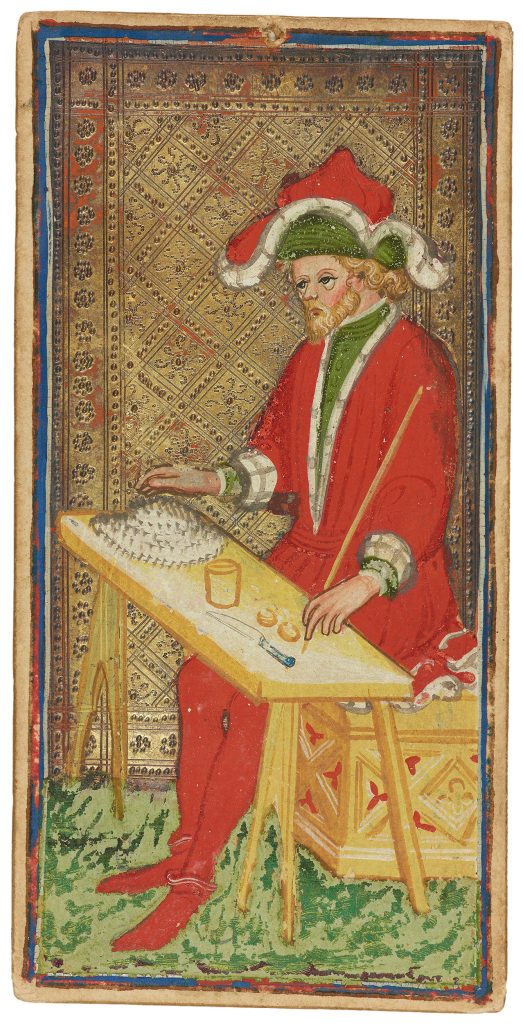
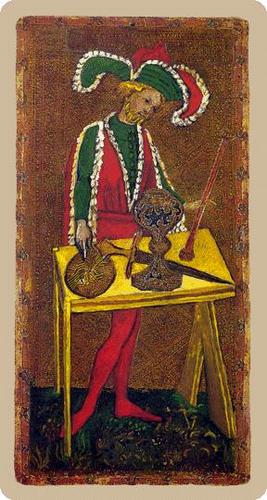
You might notice a couple of things here. First, the gracious and commanding symbol of the Magician from the Waite-Smith pack is not to be seen. Instead we have a couple rather shifty looking characters. The first looks like a con man about to sell you the Eiffel Tower - or perhaps tell you about the inheritance which you can receive as soon as you pay a small amount of money to a friendly Nigerian business man… The second has replaced the trinkets on the table with impressive examples of the suits: a large disk; a sword; an ornamental chalice and a baton.
We’ll now move forward to the Magician of the 18th century.
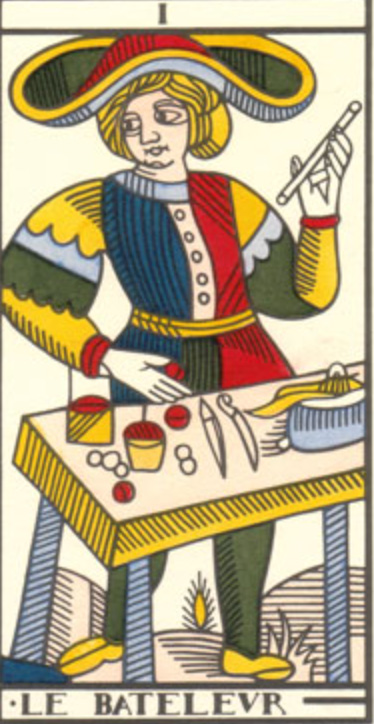
Nope. Still the shifty con man. You may notice however, that this card has two features missing from the earlier Italian cards. Firstly, it has a number - secondly it has a name.
The card is named “Le Bateleur”. A bateleur was basically an entertainer or fairground performer, skilled in sleight of hand and often a trickster or con man. Sometimes the word is translated "Mountebank".
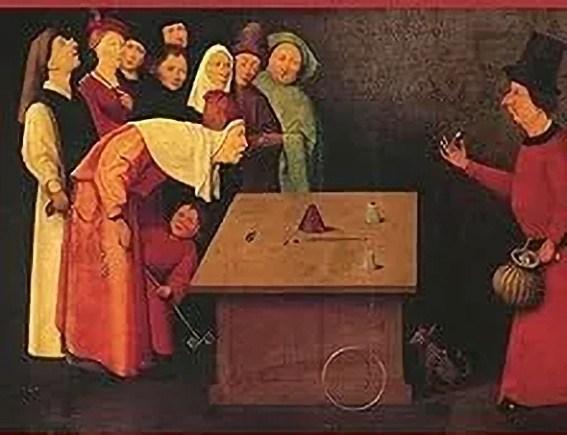
You can see the deception elements clearly in this depiction of the fairground magician. The performer is engaging the attention of a member of the audience, while his assistant, a small child, is cutting the victim’s purse from his belt.
Realm-2 is saying something important to us here. It says that normal consciousness deludes and distracts us. We exist in a state of illusion. Module One of Level One of the Wyse Art asks us to find and name our “distractor”. Is it a need to boost our self importance? Perhaps we need mental explanations and frameworks for everything. Or perhaps our emotions are so tied to our sense of self that we are incapable of relating to other people and life events objectively. There are many deflectors … Surprisingly, or not so surprisingly, 80% of people avoid naming their own deflector. I guess they are “deflected” around the question ☺️
What Le Bateleur says to us is, “It is somebody else’s fault!” Leaders and governments know this one well. Something goes wrong and the first impulse of the “Conjuror” consciousness is to point the finger at the government, or perhaps a parent, or other people in the community we feel have mistreated us. The challenge of this card is to take responsibility for our own actions, which is both terrifying and empowering at the same time. It takes a whole cycle from 1 to 9 before we arrive at the next expression of One: that is, Ten. The lesson of Ten is the completion of the process begun at One. One teaches us to commence with self. Ten says, "This 'self' has created my world.
We have followed Realm-2 as it transformed the impulse which worked through Margaret Porete in the 14th century into the Quietist movement of the 17th century. The same impulse is portrayed in the Tarot. “One” is depicted as a trickster consciousness which wants to distract us from the real. The Quietist answer was to leave this consciousness behind and become very still and in that stillness allow Reality to speak to us.
Even though “The Juggler” will evolve into a grand “Magus”, it still has a message for our modern times. “What are you looking at?” It asks. “Take another look, things are not always what they seem to be.”
Next time: The Builders. Building a new Temple through the re-emergence of the ancient esoteric teachings.