
Firstly:
Thank you! to everyone who has so far commented - encouragingly - on this project. In fact, more comments came about the Tarot than anything else so far posted ☺️ The popularity of the Tarot with people who are esoteric or occult students, spiritual seekers - or simply want to know what's going to happen - is remarkable. Especially when we consider that the Tarot cards were never created with all these ends in mind. So, our post today is:
Why Tarot?
Why the Tarot? What is it about a large pack of cardboard cards, covered in illustrations that range from the minimalist to the the colourful to the bizarre which has captured the imaginations of millions and millions of people since the end of the 18th century?
When I was eighteen, I was tantalised by the mysterious cards. They were, along with the mandatory crystal ball, the archetypal symbols of the fortune-teller. Somehow, they were supposed to open a window on the future and allow us a peep into possibilities and potentials.
When I was twenty-one, some kind person gave me my first pack of Tarot cards. They were miniature cards, not the full-size pack, but I didn’t care. I felt I held in my hands a great key. Now if only I could find the door and the lock that this key fitted…
The Tarot was not always the Tarot. It originated as a set of cards to play the game of carte de trionfo, an Italian card game that featured, as well as four suits, twenty-two ‘triumph’ cards to take tricks. The game became a favourite with the nobility, some of whom commissioned well-known artists to create spectacular hand-painted decks.
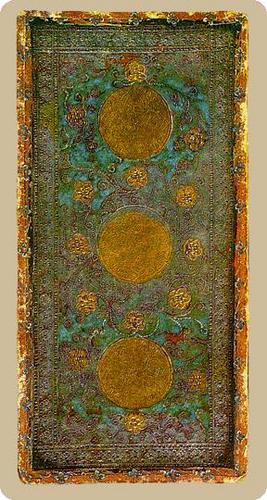
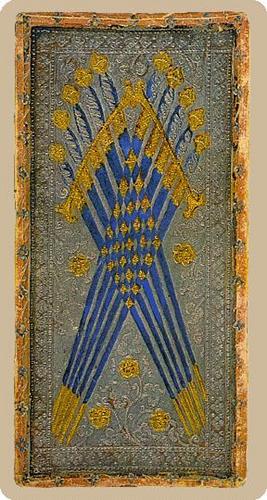
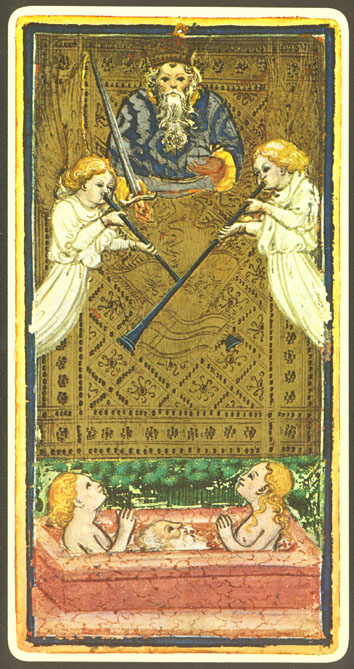
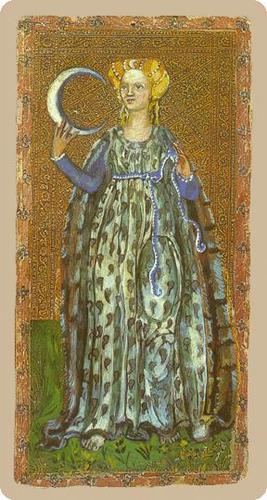
These particular cards are dated between 1450 and 1480. They were commissioned by a member of the Visconti-Sforza family who ruled the Duchy of Milan during the Renaissance. Probably they were hand painted by the famous artist Bonifacio Bembo. These are quite exquisite art miniatures. Hopefully the Duke of Milan had a lot of fun playing the Tarocchi game with them.
Card games were not just played by dukes and counts and other nobles - they were something even poor people could afford. So what did their Tarot cards look like?
The short answer is, “We don’t know!” Why is that? Well, you probably own a pack of normal playing cards. What do you do with them when you have finished? If you are like me, you consign them to the dustbin - or at least to the recycles. We can be quite sure that they will not be found by art historians in 500 years time.
The first mass produced cards have been named the Marseille Tarot because they emerged from workshops in the French city of Marseille. The earliest surviving pack is dated to 1639 - so quite a long while after the aristocrats were having fun. However, there is some evidence that these cards were being produced more than 100 years earlier. Researchers have found two sheets of uncut cards thrown away by the printer which date to 1500. In another strange discovery, archeologists investigating an old castle in Italy discovered a few cards with the Marseille design down an old dry well shaft. Apparently the workmen (French) had been sitting around playing cards and lost a few down the well. The scenario is familiar to me - when I was 18 I worked for the Parks and Reserves Board in Christchurch - which meant planting native shrubs and doing general gardening. When it rained, the foreman would bring out a pack of cards and we would play poker…
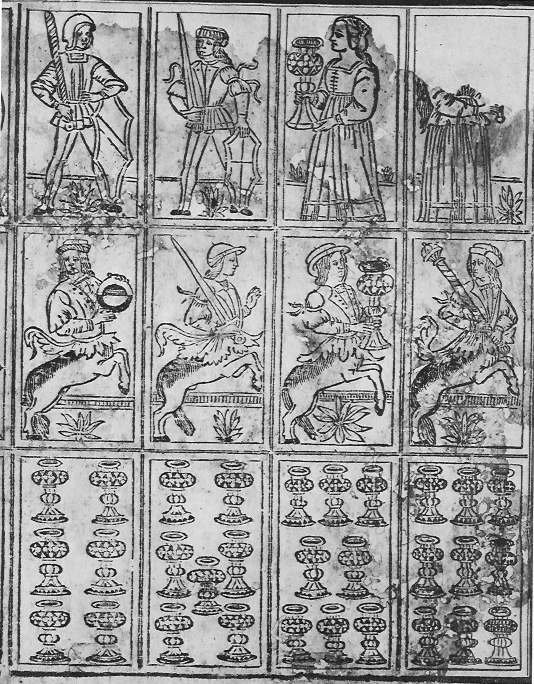
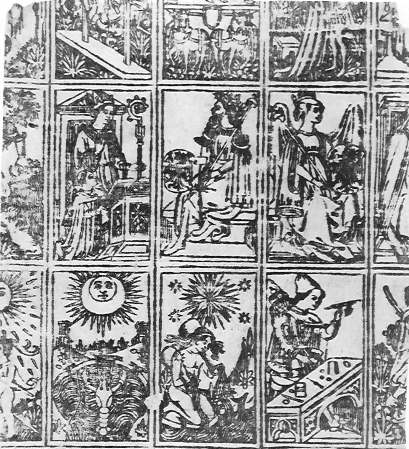
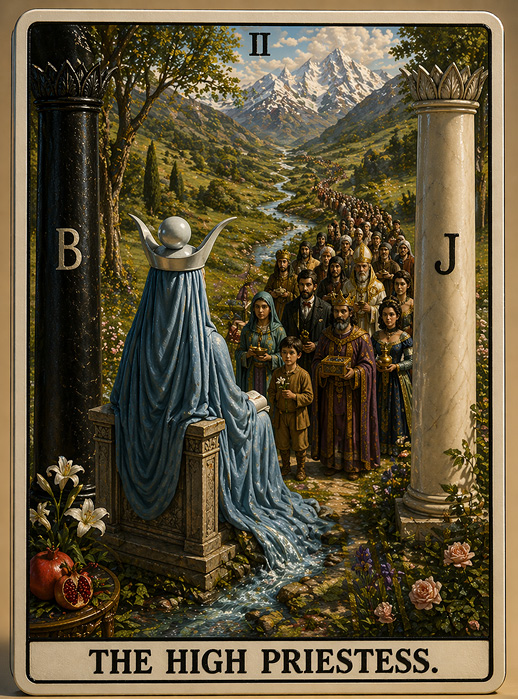
Wondering what the originals would look like, I asked Gemini AI to reconstruct a couple of new cards. The results were remarkable:
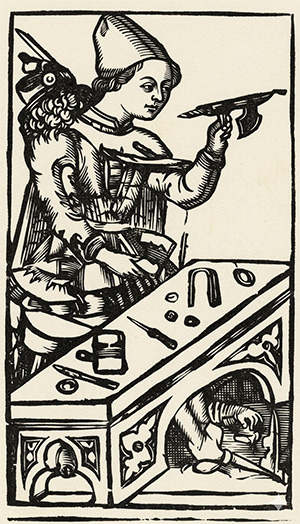
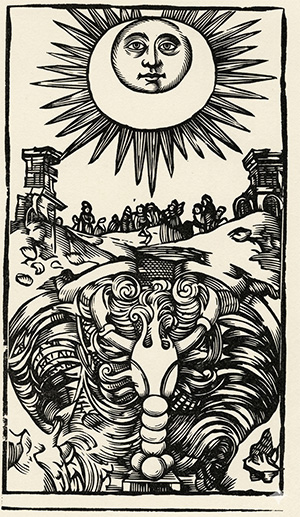
If you compare these woodcut engravings with the lavishly illustrated cards of the Visconti family you will notice a couple of things. Firstly of course, the difference in opulent artistry; but secondly the design of the Moon card.
It was not the genius of a Renaissance painter that would prevail and last for five hundred years - it was an anonymous design; mass produced on primitive technology and used by workers, labourers and merchants as a game of trumps and tricks that would evolve into the modern, mystical, esoteric Tarot.
What happened - and why?
More in our next blog: Realm-2 Takes an Interest
References
A Wicked Pack of Cards, Ronald Decker & Michael Dummett
https://tarot-heritage.com
From a Different Perspective
If you click on the picture, you will see a high quality version of the image.